In a small glass cabinet at the Science and Industry Museum in Manchester, England, there are three red transistors. On June 21, 1948, these transistors were part of the first programmable electronic computing device, nicknamed “Baby.” Much like the invention of the spinning jenny in that same city almost two centuries prior, it’s difficult to overstate the impact that this technological development had on humans and their planet.
Today, just down the street from where those transistors first sparked to life, a team of visual artists and dancers have attempted to grapple with the consequences of that remarkable moment 75 years ago. Free Your Mind is a result of a collaboration between Academy Award-winning director Danny Boyle, choreographer Kendrick ‘H2O’ Sandy, composer Michael ‘Mikey J’ Asante, designer Es Devlin, writer Sabrina Mahfouz, and costumer Gareth Pugh. Whether they realize it or not, their efforts sit firmly within the science fiction genre.
Kinetic, engaging, and occasionally baffling, the production is an immersive musical stage experience about our relationship with technology. Told primarily through dance, costuming, and instrumental music, the production takes its cues from the 1999 movie The Matrix, but to call it a stage adaptation would be reductive. Rather, this is a meditation on the Wachowskis’ masterpiece, on its continued relevance, and on the ideas that informed the movie’s making.
“[The Matrix] has almost become prophetic,” Asante said. “It’s spoken about where we are and the digitization of the world and how we’re interacting with our digital footprint.”
It is not always successful, but it is ambitious.
Created to help launch Aviva Studios—a $300-million arts hub in downtown Manchester—Free Your Mind is a Brechtian production that guides its audience through multiple performance spaces in the building. When Boyle and his collaborators were invited to create the inaugural performance at Aviva Studios, The Matrix seemed like an appropriate story to draw audiences into the building.
“Everybody has The Matrix in their language to one degree or another,” Boyle explains. “I remember seeing [The Matrix] and thinking that it was really impressive, but I was a bit baffled by it to be honest. Over time, it swims into focus more and more.”
Pre-show, attendees can mingle with actors wandering through the lobby and bar in character, consider various related art pieces, and follow QR-code portals to augmented reality. During intermission, bullet-time re-enactors steal the off-stage scene, helping connect audience members to the world of the movies.
(Opening 18-10-2023)
©Tristram Kenton
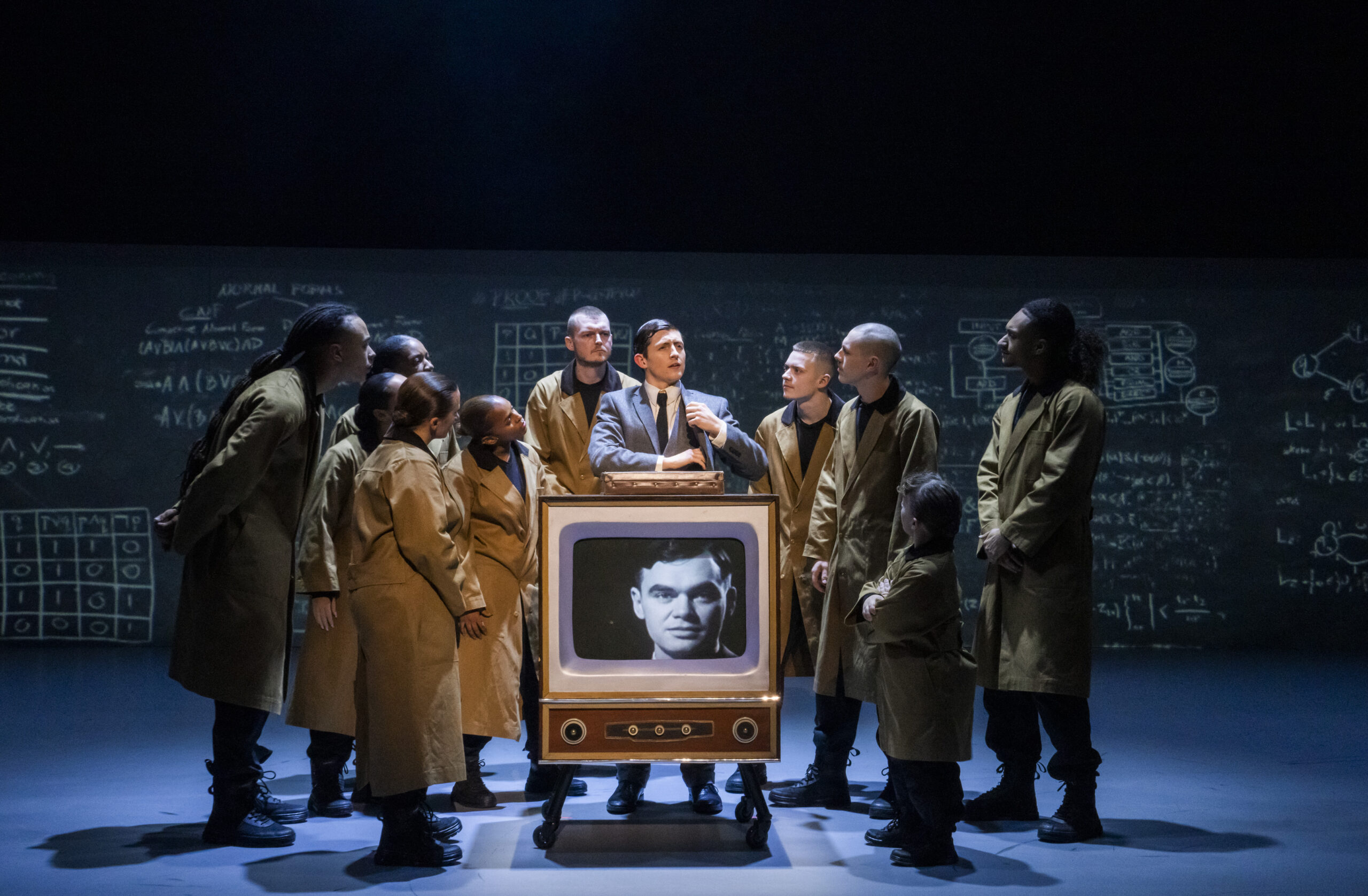
But we’re getting ahead of ourselves. A televised deep fake of Alan Turing opens on stage 1 with a monologue about the entwined histories of computing and Danny Boyle’s hometown of Greater Manchester. A steady beat overtakes the speech as dancers (one of whom is costumed as Turing) perform a mechanical, intricate choreography culminating in Turing’s untimely end. Are they suggesting that Turing was a spiritual forebearer of Neo? Both rejected the Matrix’s heteronormativity…and were punished for it. It’s unclear how to interpret the scene, but it sets the participatory rhythm for the audience: pay attention, draw your own conclusions.
(Opening 18-10-2023)
Photo by Tristram Kenton .
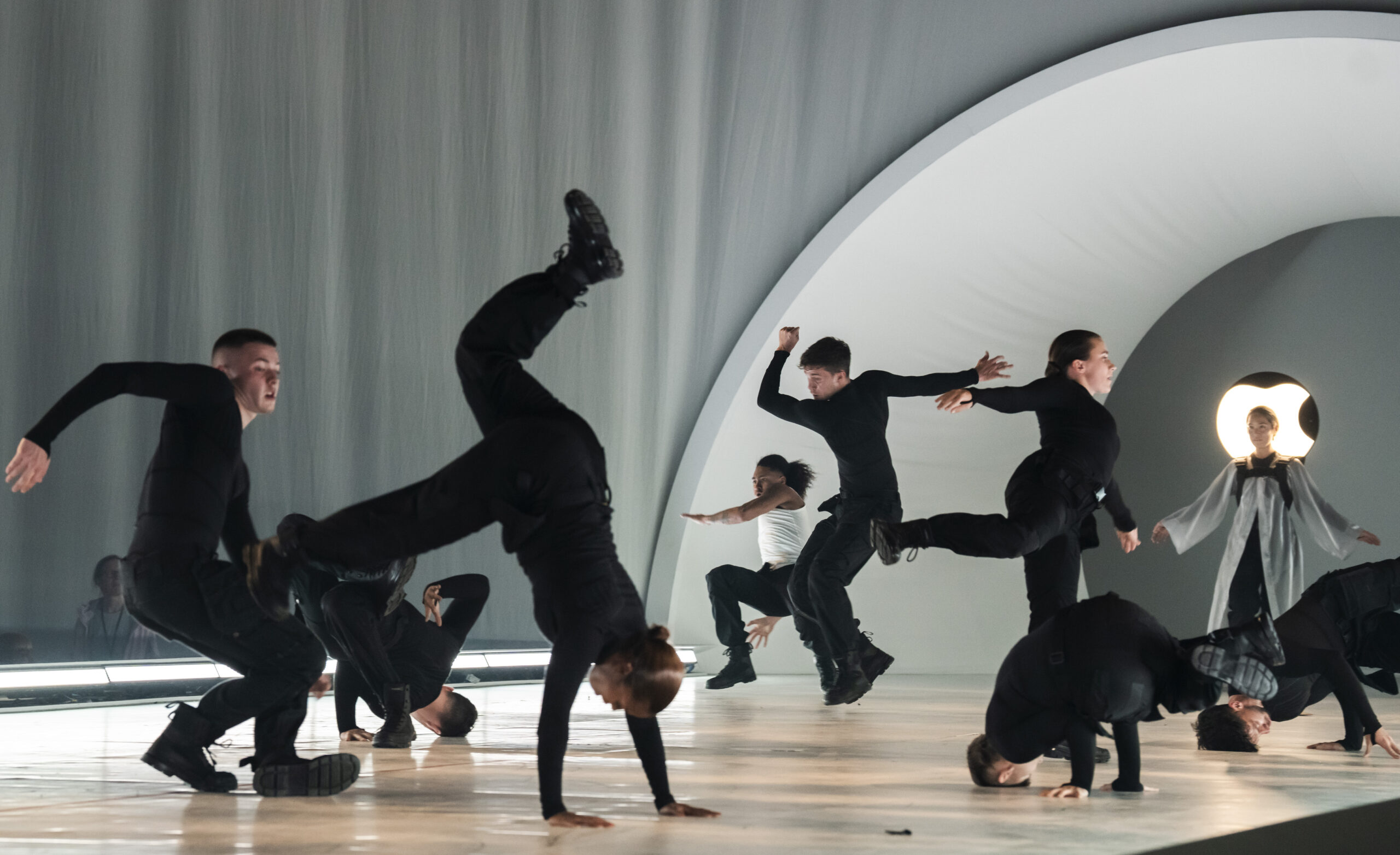
From there, participants are taken on a journey through the narrative highlights of the first Matrix movie; Neo’s awakening to the world around him, the training scenes, his first meeting with Trinity, the bank heist rescue of Morpheus, and the climactic battle with Agent Smith. This is all communicated through dance and without dialogue, save for an occasional statement from above. Taking clear inspiration from Yuen Woo-Ping’s iconic fight sequences, many of these scenes serve to highlight just how groundbreaking the original movie’s combat sequences were. There are few Hollywood blockbusters that could translate this well to modern dance.
Those who are less familiar with the movies’ plot elements may have difficulty piecing together the through-lines. Consequently, some of the show’s most powerful segments are the ones least connected to the original movie.
Among the highlights of the first half of the show are the non-diegetic inserts inspired by The Animatrix (the 2003 animated anthology detailing the back-story of the Matrix universe). In an effective and affecting dance number, the murder trial of android B1-66ER (with costumes that are impressively close to the animated characters) is reenacted.
In place of an intermission call is a command to “follow the white rabbit,” as ushers in bunny costumes and trench coats guide attendees to a lounge and through to The Hall (a space significant enough to require capitalization). The Hall is vast—cavernous even. Large enough to fit the Statue of Liberty…and with enough rigging equipment to lift that 225-ton statue off the ground, its massive array of television screens guides the audience through the second half of the production.
The show continues to cleave away from established Matrix lore. Modern dance sequences set to sometimes mismatched music encourages the audience to examine the ways in which our relationship with social media has become entrenched and problematic. One particularly effective piece involves dancers moving about the stage while transfixed by the eerily bright cell phones almost grafted to their hands, seemingly oblivious to Neo and Trinity’s fight going on in their midst. There’s a McLuhanesque element to this; technology is more than just an extension of ourselves, it is a part of us.
It’s been almost a quarter century since the Wachowskis’ masterpiece hit the screens and first introduced us to Agent Smith, and our relationship with computing technology has evolved; Free Your Mind’s exploration of this evolution is provocative and occasionally insightful. That being said, the show has three competing goals that pull it in different directions. Not only is it adapting The Matrix, it’s also providing snippets of the history of Manchester, and thus the history of modern capitalism and its influence on the lives of workers. Like the industrial city of the eighteenth and nineteenth centuries, the impressive capabilities of Aviva Studios are pushed to their limits and used to launch new ideas and practices. When these goals are in harmony (as in the opening number), the show soars.
The audience for an immersive dance performance is very different than that of a populist blockbuster—and it may be difficult for those without a deep knowledge of The Matrix to parse out the plot of Free Your Mind. But we suspect that the careful choreography and the sheer spectacle might be enough to draw a broad audience. For some, it might even serve as a gateway to more science fiction.
Despite the occasional pirouette into pretentiousness, Free Your Mind ultimately succeeds. The creators of this “musical experience” have not adapted The Matrix to the stage, but rather have offered audiences a work that is in conversation with it. In doing so, it makes a case for the enduring value of The Matrix. Few—if any—other science fiction films of the past 50 years could justify as ostentatious and high-minded an interpretation.
Free Your Mind ran from October 31 to November 5. At present there are no plans for the production to be restaged.
Photos of Free Your Mind by Tristram Kenton, October 2023
© 2024 Amanda Wakaruk and Olav Rokne